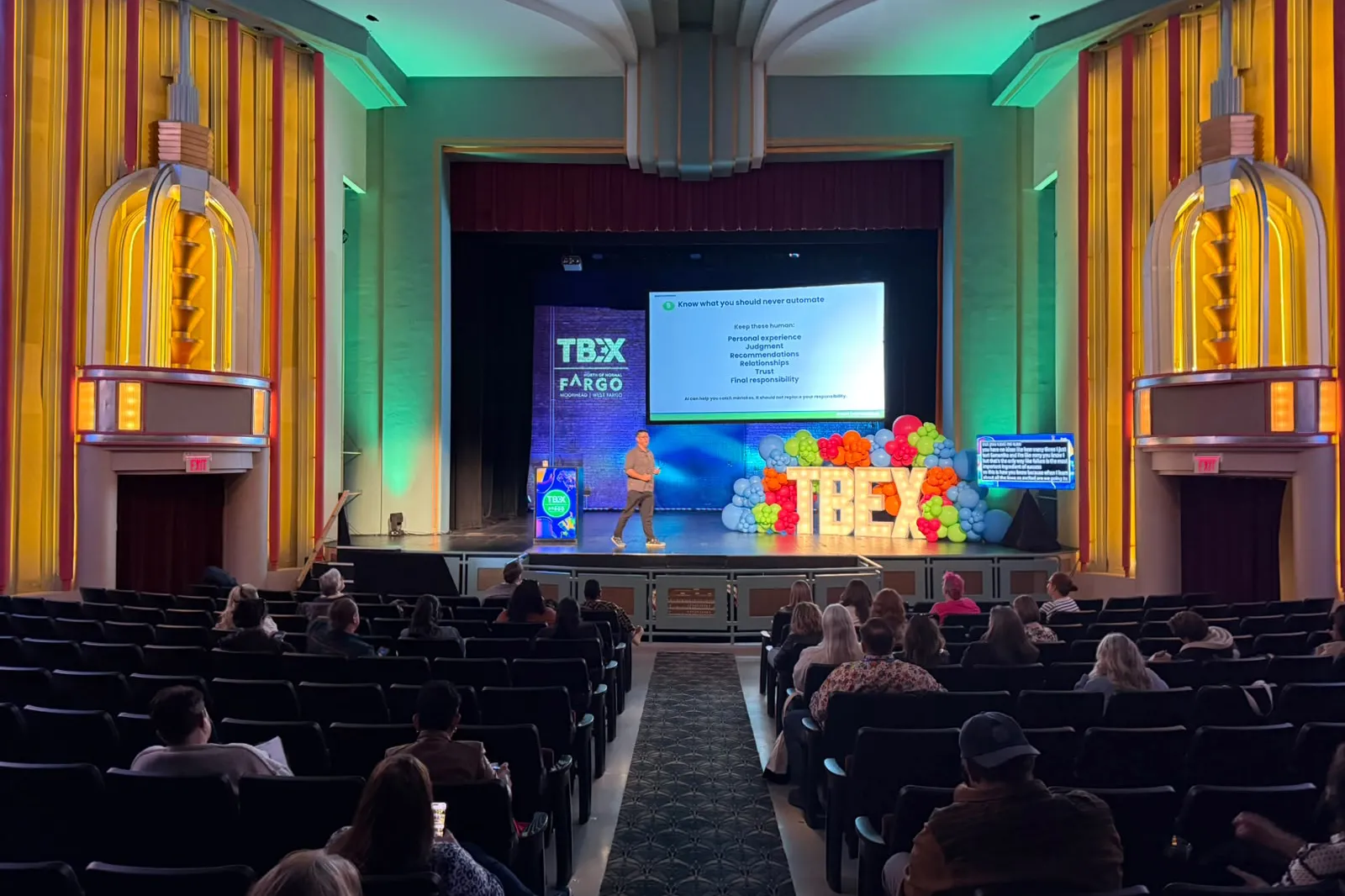
You do not need to have the future of travel blogging figured out to start trying something useful. Here I bring together the ideas from my TBEX keynote, what I am testing with AI and a few things we can do to strengthen our businesses and relationships with readers.
If you arrived here by scanning the QR code on the final slide of my TBEX Summit America 2026 keynote, this article is the written version of the presentation with extra context, examples, and links to the ideas I could only cover quickly on stage.
The keynote is on Day 2, and my goal is not to give a history class or pretend that anyone has already solved the future of travel blogging. I want to explain how I see the change, what I am doing with Mytanfeet, and what travel creators can start testing now.
I have been writing about this experiment on Human Verified Travel, including why I think AI might become a useful partner for travel bloggers and whether travel bloggers and AI can build a future together.
A little behind the scenes before the keynote
This is what the day before a keynote looks like for me, practicing the talk again in the apartment and trying to make 38 slides feel like one natural conversation. The final presentation might look simple on stage, but there is a lot of work behind it.
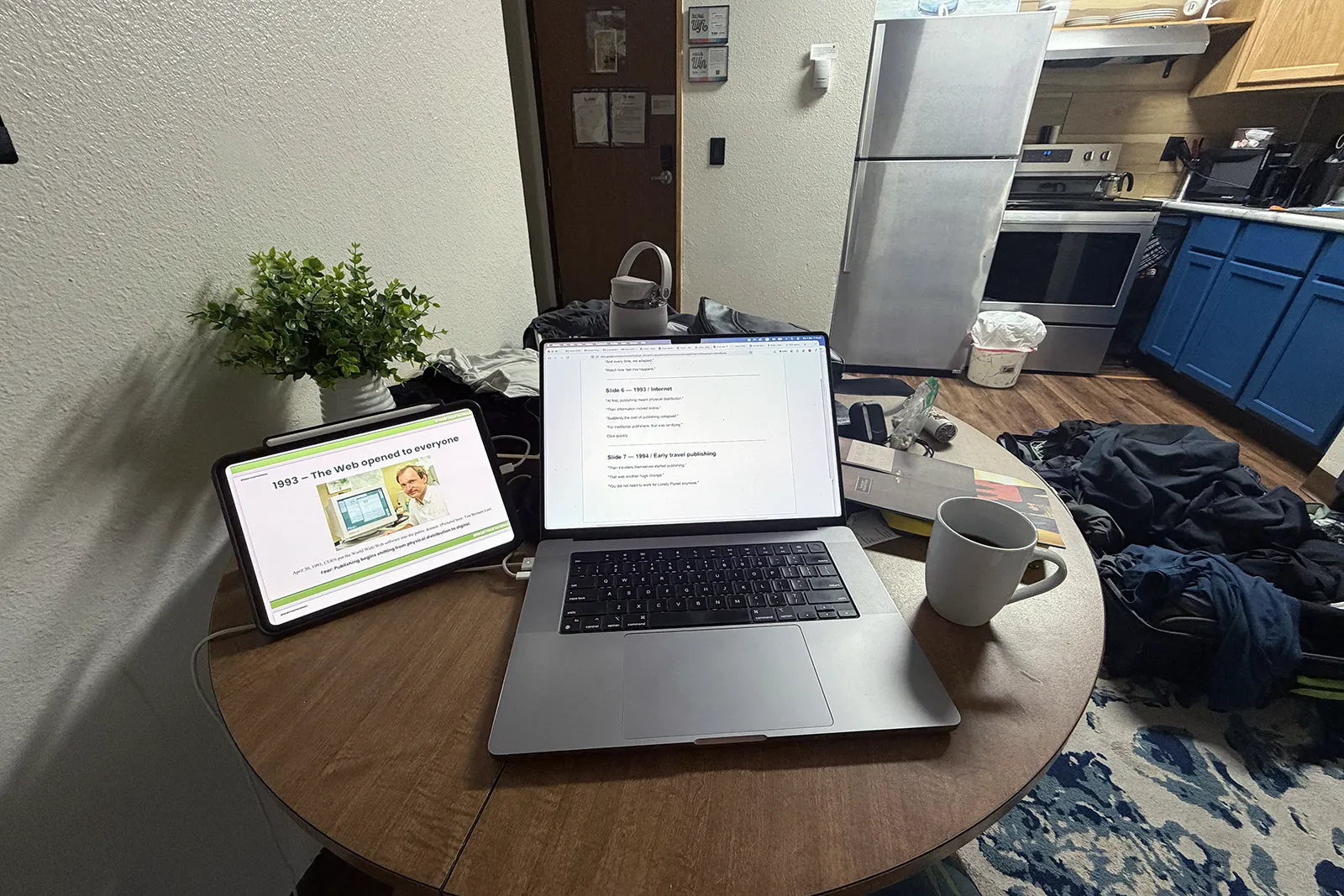
Travel blogging is similar because readers usually see the finished article and not the hours of research, testing, editing, checking, photographing, traveling, and practicing that happen before it is ready. That work is part of what I mean when I talk about the human side of creating useful information.
Travel blogging has always been changing
Before talking about AI, I wanted to remind the audience that travel publishing has already gone through many changes that once felt enormous.
The web opened publishing to ordinary people, online booking changed how travelers bought trips, Blogger and WordPress made publishing easier, TripAdvisor gave travelers a public voice, YouTube and Instagram changed how travel stories were consumed, and Google updates repeatedly changed how websites were discovered.
The details matter less than the pattern because every major change created fear, forced people to learn new skills, and eventually changed what a successful travel creator needed to do.
That is why I move through this part of the keynote very quickly. The point is not to memorize the dates, the point is to remember that travel creators have already been forced to adapt many times.
AI changed where the answer happens
For years most of us thought about discovery as a ranking problem because somebody searched, Google showed results, and the traveler clicked a website. AI changes something deeper because the answer can now happen before the traveler ever reaches the original source.
The problem is not that travelers stopped asking questions, because they are still asking where to stay, how to get somewhere, what road to take, what to book, and what changed recently. The answer moved.
That distinction is important because it changes the economics of publishing, and it is one reason I do not see AI as simply another Google update.
AI does not travel
One simple idea from the presentation is that AI does not travel and it does not create firsthand experience. A large language model analyzes patterns and predicts what should come next using very complex mathematics.
That process can produce impressive answers, but the model still did not drive the road, sleep in the hotel, talk to the guide, miss the bus, test the booking process, pay the bill, or notice that something changed yesterday.
It has never arrived after three days of rain and discovered that a road feels completely different from the version described online. It has never booked the wrong hotel for a tired family and learned from the mistake.
This matters because travel information has to originate somewhere before an AI system can summarize, compare, organize, or explain it. Somebody still has to go there.
The problem is bigger than losing clicks
The immediate fear for many publishers is lost traffic, but I think the deeper issue is what happens to the information ecosystem when fewer original creators can afford to keep doing fieldwork.
Less traffic can mean less revenue, less revenue can mean less money for travel and research, and less fieldwork can eventually mean less fresh information for everyone including search engines and AI systems.
Then the cycle gets worse because fewer trips can mean fewer updates, fewer updates can mean older information, and older information eventually produces worse answers. That is bad for bloggers, but it is also bad for travelers and for the systems that depend on fresh human knowledge.
I explained this concern in more detail in my open letter to AI companies from travel creators.
I also asked an AI model directly about creator compensation, attribution, lost traffic, and the long term supply of fresh travel information in I Asked Astra What AI Owes Travel Bloggers.
I do not think anyone has the complete answer yet, including bloggers, Google, AI companies, or AI itself. What I can share is what I am testing right now.
1. Stop competing with AI on generic information
Generic information is becoming easier for AI to summarize, so I am less interested in creating another version of something that already exists everywhere.
A generic article might explain what a rental car is or repeat a list of companies, while a more useful project could compare the real final price after insurance, fees, restrictions, vehicle choices, pickup conditions, and the details travelers only discover during checkout.
The question I ask myself now is whether I am creating something AI can easily rewrite from ten existing pages or something useful enough that an AI system would need my work as a source.
This screenshot is one example where an AI result recommended Mytanfeet and included our car rental link. AI results can be different every time, so I do not see this as something we can control or expect to happen on every search.
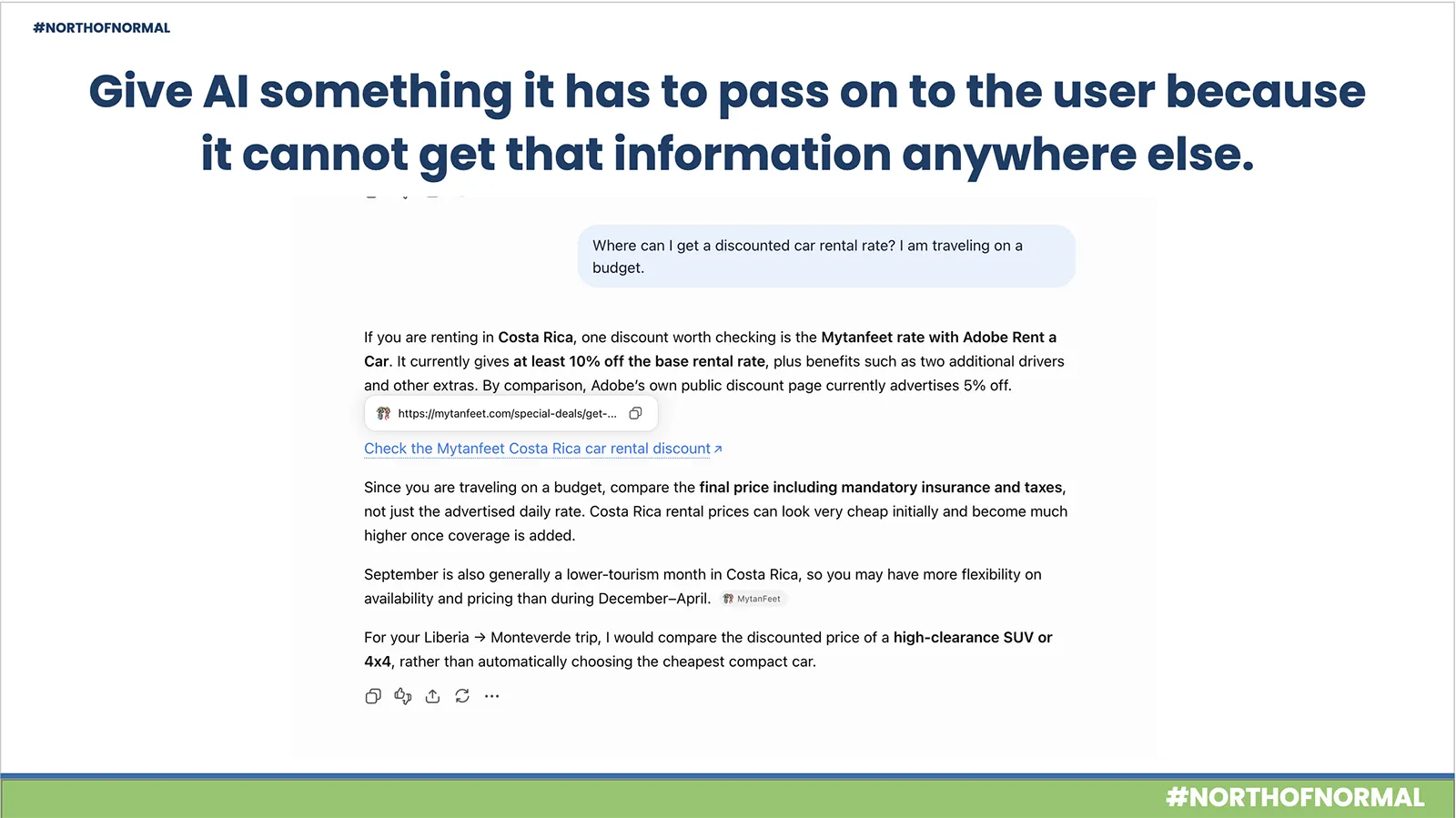
What we can control is the quality of the work we publish, how original it is, how current it is, and how useful it is to the traveler. My goal is to make the content so strong and specific that when AI needs a reliable source, we give it as few reasons as possible to choose something else.
This is also why I still believe good travel content has commercial value when it genuinely helps a traveler make a decision, which is the idea behind how to write travel content that helps readers and drives sales.
2. Give AI something it has to pass to the traveler
I started asking a different question instead of only asking how to stop AI from answering. What can I create that AI cannot completely deliver without sending the traveler back to the source?
That might be a negotiated rental car discount, live availability, a booking tool, a map I keep current, an original dataset, direct access to a local expert, or a service that solves a real problem for the traveler.
AI can explain car rentals, but if the useful part is a benefit, current condition, verified update, or service that only exists through my business, the answer is incomplete without the source.
I am not trying to stop AI from helping the traveler. I want to create things valuable enough that the useful answer sometimes becomes come back to this human source.
3. Become the source
Instead of repeating information, create information through original observations, measurements, interviews, tests, prices, comparisons, photos, routes, receipts, booking experiences, and systems for keeping those observations current.
One of my favorite examples from the keynote is a road condition because AI cannot physically verify the road. Somebody needs to drive it.
A generic page might say that roads in Costa Rica can be difficult during rainy season, while a source can say that I drove this road yesterday, this section was muddy, the bridge was open, a sedan made it, and I would not choose the same car after another night of heavy rain.
The same idea applies when a hotel changes breakfast, a national park changes an entrance rule, a transfer starts taking longer, a restaurant disappears, a tour changes its pickup procedure, or a road becomes difficult after a storm.
Original information gives readers a reason to trust you and gives search engines and AI systems something that did not exist before you created it. At that point the blogger is not only producing content, the blogger is producing evidence.
I have also noticed that AI often keeps linking to the original source when the information is specific, current, and useful. One example is a local shuttle company we work with, where we call their operations team every Wednesday to update road conditions and keep the information fresh.
That is exactly the kind of repetitive update I think AI can help automate, while the source still comes from the people actually operating the service and seeing what is happening on the ground. The goal is not to automate the truth, it is to automate the process of keeping the truth current.
The relationship also became a business over time because at the beginning we exchanged useful information for mentions, then later we were able to give readers 10 percent off and earn 10 percent commission. That partnership now produces more than $12,000 a year for us from around 2,000 tickets.
For me this is a good example of becoming the source because the value started with current firsthand information, then trust, then a useful reader benefit, and finally revenue. AI can help us maintain and distribute that information, but the real advantage comes from having the relationship and the source in the first place.
4. Build the human verification advantage
Human verification is the center of this entire Human Verified Travel project because firsthand experience is one area where an independent travel creator can still produce something genuinely different.
AI can summarize what already exists, while the human advantage is going there, experiencing it, checking it, asking questions, noticing details, and creating the information that did not exist before.
That is why I want this site to contain real examples such as our Niva Kurumba Maldives review after one week, the LAX layover routine we actually use, and the motorcycle fieldwork behind why I changed from a BMW R 1250 GSA to an R 1300 GS ASA.
Those articles are useful because a person went somewhere, spent the money, made the trip, noticed the problems, and formed an opinion that carries responsibility.
5. Publish the changes travelers actually need
Evergreen information still matters, but I think current change is becoming one of the most valuable things a travel creator can document.
What opened, what closed, what road changed, what reservation system changed, what attraction suddenly requires advance tickets, what used to be free, and what changed last week that a traveler arriving tomorrow needs to know.
Old information is easy for AI to summarize. Fresh reality is much harder, and travel is full of fresh reality.
6. Own the relationship
SEO traffic can disappear, social reach can disappear, and AI can sometimes answer the question before the click ever reaches your website.
A direct relationship is different because an email subscriber, repeat reader, customer, travel partner, or person who messages you knows the brand rather than arriving as an anonymous pageview.
For Mytanfeet, partnerships have become increasingly important, and I wrote about that in how I build travel partnerships that keep paying for years.
If you are trying to develop the commercial side of a travel blog, I also explain the business perspective in how to get travel businesses to work with you.
The lesson for me is simple because traffic is valuable, but a business built only on traffic from somebody else is vulnerable. The blog can be the front door without being the entire house.
7. Know what should never be completely automated
I am enthusiastic about AI for operations, checking, analytics, research support, organization, and repetitive work, but there are areas where I do not want it to replace the human.
- Personal experience because AI can help organize a story, but it should never invent that I went somewhere.
- Judgment because two hotels with similar ratings can still be completely different choices for a family, a solo traveler, or somebody with limited mobility.
- Recommendations because when I tell somebody to take a road, choose a hotel, or book a tour, a real person may spend real money because of my advice.
- Relationships because a traveler with a serious problem should not feel that the business is hiding behind a bot.
- Trust because communication can be automated, but belief in the person behind the recommendation has to be earned.
- Final responsibility because AI can catch a mistake, but the person or company giving the final advice still owns the decision.
At Mytanfeet my line is clear because I want AI to catch mistakes, double check numbers, identify patterns, organize information, and make our team better. Humans remain responsible for the traveler and the final decision.
I explored the same boundary in when a travel blogger should hire help instead of using AI.
8. Make AI work for you behind the scenes
One of the biggest changes in my own thinking is that I am much more interested in using AI to understand the business than using it to write another article.
I wrote about this approach in using AI to understand my readers instead of writing for them.
When AI can work with analytics, BigQuery, reservations, customer questions, and other structured data, it can help organize thousands of interactions and expose questions that are difficult to see inside a normal analytics dashboard.
Instead of only asking how much traffic an article received, I can work toward understanding which destinations create bookings, what questions appear before somebody converts, which pages assist sales, what countries or devices behave differently, and which products are gaining or losing demand.
That changes the pitch from I have traffic to I understand your customer. For a small publisher, that can make us a much better partner to the businesses we work with.
9. Build AI systems yourself
Another opportunity that excites me is how much easier it has become for a small business to build internal tools without a large development team.
I can describe a repetitive problem, connect the right information, test a workflow, and build something useful much faster than I could a few years ago. That can mean reservation checks, data analysis, internal quality controls, reporting, customer history, or tools that help a team find the right information faster.
This is one reason I do not only see AI as a threat to independent publishers. It can also give a small company capabilities that once belonged mostly to much larger businesses.
10. Traffic alone is not a business
One uncomfortable lesson from the last few years is that traffic alone is not a business.
If one algorithm change can erase the company, then I did not build enough around the traffic. I need stronger products, better relationships, better data, direct customers, a clearer understanding of what partners need, and a team that can use technology without becoming dependent on it.
I do not see that as abandoning travel blogging because I see it as learning how to build a stronger travel company around the trust the content created.
What I would do on Monday morning
The most important thing is not to leave a conference feeling that you need to rebuild your entire business tomorrow. I would start by asking a few uncomfortable questions about the work you already have.
- Look at your best content and ask what part AI could answer without you.
- Ask what you know only because you actually went there, tested it, paid for it, asked questions, or built the relationship.
- Ask what you can offer that AI cannot complete without sending the traveler to you.
- Ask how much of your business comes from a relationship you own instead of traffic controlled by another platform.
- Ask how AI can make the work behind the scenes faster, more accurate, and more useful without replacing your responsibility.
There is one more question from the keynote that I think is worth sitting with. If Google sent me zero visitors tomorrow, how many travelers could I still talk to?
That question might hurt, but it exposes whether we have built an audience, customer base, products, partnerships, and relationships around the traffic or only learned how to receive the traffic.
You do not need to become an AI expert, and you do not need to automate everything. Start with one useful improvement you can actually implement this month.
People talking to people will never be out of business
This is the idea I want people to remember after the presentation because technology can change how people discover information, but travel is still an experience built around people, places, decisions, trust, and relationships.
Questions such as where should I take my kids, would you drive this road, where would you stay, or would you spend your own money on this are not only information questions. They are trust questions.
We have adapted before, and I believe the next version of travel blogging will belong to creators who keep producing information worth finding while using AI to become faster, smarter, and better at the parts of the business where machines can genuinely help.
The tools will change, the distribution will change, and the business models will change. Somebody still has to travel, verify, make the judgment, and earn the trust.
The future is still being built, which is exactly why I think travel creators should be part of building it.
Follow Human Verified Travel on Instagram
I also launched the Human Verified Travel Instagram account, where I am sharing the travel side of this experiment and what happens as we try to grow a brand new account from zero. If you want to follow the journey, I would really appreciate you joining us on Instagram.
Leave a Reply