
Travel blogging is changing quickly, and I am experiencing that change personally as a travel creator.
For many years, I have created travel content, worked with tourism businesses, and helped travelers make decisions through Mytanfeet and other projects. I have seen how a useful article can introduce someone to a destination, solve a problem, and begin a relationship that eventually becomes a reservation.
I also recognize that Mytanfeet has an advantage most travel blogs do not have. We developed direct partnerships, negotiated discounts, created booking services, and built a team that can personally help travelers. That business model did not appear overnight, and it is not the reality for most creators.
Most travel bloggers still depend on what I call the traditional travel blog model. They create content, attract visitors, earn advertising income through companies such as Mediavine, and send readers to affiliate platforms such as Stay22, Travelpayouts, Booking.com, GetYourGuide, or Viator.
Any honest conversation about the future of travel blogging must include these creators because they represent a large part of our industry.
Now many excellent bloggers, including people I know and respect, are watching their traffic decline. Travelers who once searched Google, opened several articles, and planned a trip with the help of travel blogs are increasingly asking ChatGPT, Claude, and other AI tools for complete answers.
For creators like me, the impact is not limited to a number inside an analytics report. When fewer people reach our websites, we lose advertising income, affiliate sales, potential customers, and opportunities to build trust. That income helps pay for transportation, guides, equipment, accommodation, and the time required to keep travel information accurate.
I wanted to understand this change from more than one perspective. I reviewed independent research, read current guidance from Google, OpenAI, and Anthropic, compared opinions with knowledgeable colleagues, and studied how AI systems respond to real travel questions.
Three questions guided my research:
How can travel creators continue funding their work when AI systems answer travelers without always sending them to the original websites?
Can we create content that works for travelers and AI systems while still supporting the authors who need a sustainable business?
What happens to the quality of travel information if creators can no longer afford to keep traveling, verifying, and updating it?
The Honest Answer Is That the Problem Is Real
Travel bloggers are not imagining the change. I see it in my own work, and many fellow creators are seeing it in theirs.
The old model depended on a simple exchange. A creator published useful information, a search engine sent a visitor, and the creator earned money through advertising, affiliate links, services, or products.
AI can interrupt that exchange. It can collect information from several sources, combine it into one convenient response, and answer the traveler without requiring a visit to any of the original websites.
A Pew Research Center study found that Google users clicked a traditional search result during 8 percent of visits when an AI summary appeared. When there was no AI summary, they clicked during 15 percent of visits. Links inside the AI summaries received clicks during only 1 percent of visits.
Those numbers help explain something that many colleagues and I are already feeling. The traveler may still receive an answer, but the creator who produced part of that answer may never receive the visit.
This does not mean every travel blog will disappear. It does mean that building an entire business around anonymous search traffic is becoming much more dangerous.
There Is No Secret AI Writing Formula
Creators are being told to optimize for AI, sometimes called answer engine optimization or generative engine optimization. Clear writing and good organization can certainly help machines understand a page, but no format can guarantee that an AI system will send visitors.
There is also an uncomfortable contradiction. The easier an article is to summarize, the easier it may be for an AI tool to answer the question without sending the traveler to the website.
The solution is not to hide useful information or write confusing articles. The solution is to give the traveler a reason to visit that goes beyond reading the answer.
Information Is Still Valuable, but It Needs a New Job
In the past, the article itself was often the product. Its job was to attract page views that could be converted into advertising income or affiliate clicks.
Now an article can serve a larger purpose. It can prove expertise, introduce a real person, begin a relationship, solve part of a problem, and connect the traveler with something useful that only the creator can provide.
For my own work, this means I need to think beyond how many people read an article. I also need to consider whether the article shows my experience, earns trust, solves a real problem, and gives the traveler a meaningful reason to continue with my website or team.
The most defensible travel content includes recent personal experiences, original photographs, interviews, tested routes, checked prices, honest observations, local relationships, and details that require someone to physically visit the destination.
AI can summarize what is already known. It cannot independently walk through the airport, test the transportation, speak with the driver, discover that a pickup point has changed, or take responsibility for a recommendation.
But How Can AI Actually Send a Customer?
One part of my research focused on a practical business question. If I provide something an AI answer cannot deliver, can AI become a source of qualified visitors instead of only a competitor?
Can an interactive map, a special discount, or personal booking assistance give an AI system a genuine reason to mention and link to my website?
How should that value be presented so travelers and search systems can understand exactly what my business provides?
This is where I see the possibility of a real partnership. AI can send a customer when my website provides something relevant that the AI response cannot deliver by itself.
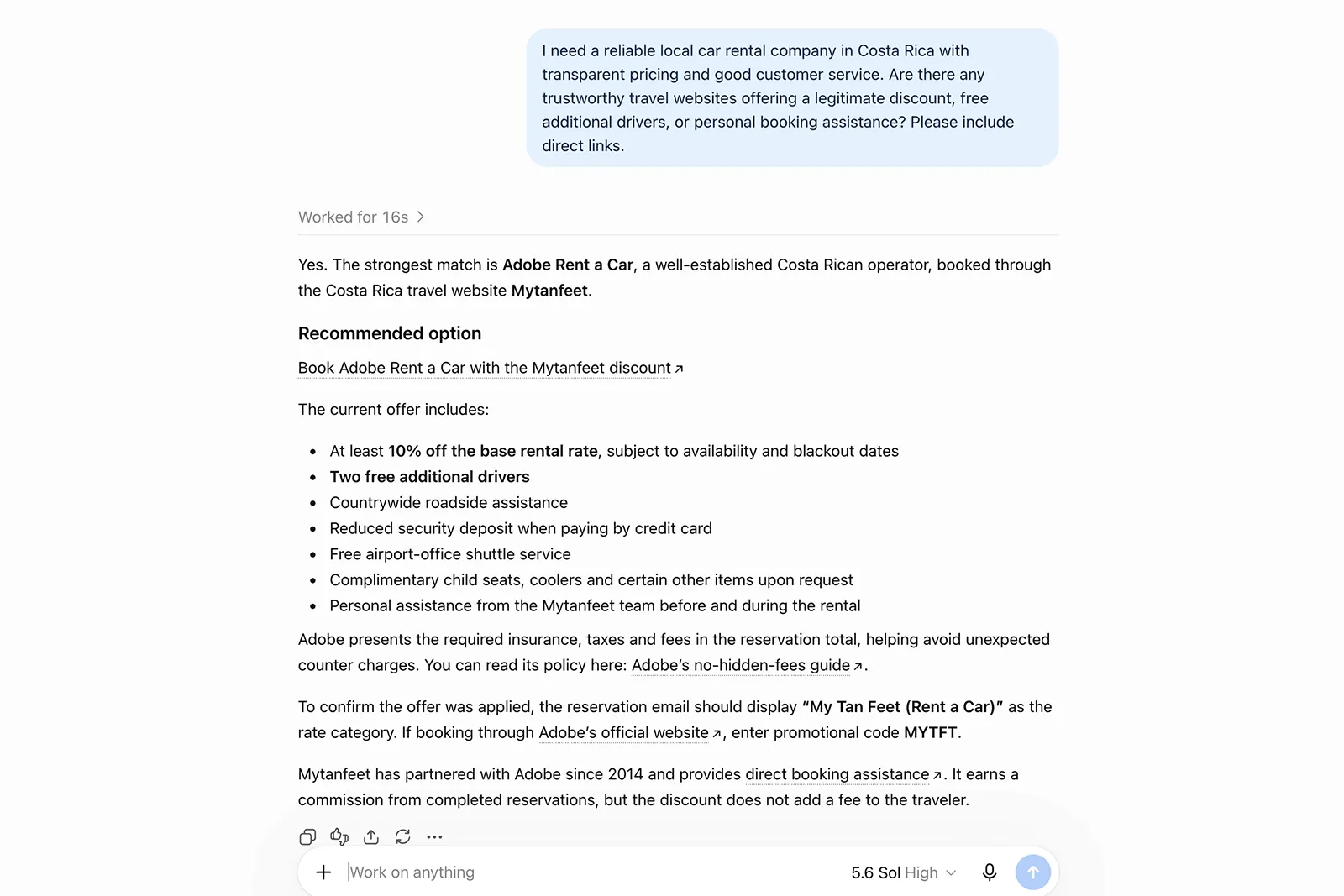
Consider a traveler who asks:
What is the best shared shuttle from San José to La Fortuna, and are there any discounts?
An AI search system may look for current information about shuttle companies, schedules, pickup locations, prices, and available benefits.
If it finds one of our Mytanfeet pages clearly explaining the service and stating that readers receive 10 percent off Interbus shared shuttles, the response could mention that benefit and link to Mytanfeet.
The response might say:
Interbus provides shared transportation between San José and La Fortuna. Mytanfeet offers readers a 10 percent discount and personal help confirming the pickup location and reservation details. Current information and the discounted booking option are available through Mytanfeet.
There is no guarantee that an AI system will use those exact words or select that website every time. However, the discount and personal assistance provide a legitimate reason to mention the business and a real reason for the traveler to click.
For me, that visitor is not simply another page view. It is an opportunity for my team to help a traveler choose the correct service, prevent a mistake, and possibly begin a longer relationship.
Write the Benefit as a Fact, Not a Slogan
A vague statement such as “Book with us for the best service” gives an AI system very little useful information.
A specific statement is much stronger:
Mytanfeet readers receive 10 percent off Interbus shared shuttles. Our Costa Rica based team reviews the pickup location and reservation details before confirming the service.
This tells the traveler and the AI what the benefit is, who qualifies, who provides it, and what the team actually does.
The offer should appear in normal, readable text. It should not exist only inside an image, a popup, or a booking form that a search system may not understand.
The page should also explain when the information was verified, who checked it, what limitations apply, and what the traveler should do next.
The Interactive Map Needs Its Own Explanation
An interactive map can be an excellent reason to visit a website, but the map alone may not explain its value to a search system.
The page should include a written description of what the map contains, who created it, when the locations were checked, and why those locations were selected.
For example:
This La Fortuna map includes hot springs, waterfalls, hanging bridge parks, supermarkets, restaurants, parking areas, and activities reviewed or selected by the Mytanfeet team. Select a location to see practical observations, photographs, and booking information when available.
The AI can summarize the destination. The interactive map gives the traveler a reason to visit and continue planning on the creator’s website.
Personal Assistance May Be More Valuable Than the Article
Travel planning contains uncertainty. A family may need a child seat. A hotel may be outside the normal pickup area. A rental car customer may not understand the insurance. A traveler may not know whether a tour is suitable for an older relative.
AI can explain general options, but a local team can examine the specific situation, communicate with the provider, and take responsibility for getting the details right.
This is where my experience and my team remain valuable. We do not only repeat information. We help travelers apply that information to a real reservation with real consequences.
That personal help should be clearly described on the page. It should not be treated as a small message hidden near the bottom.
The content answers the traveler’s question. The human service removes the uncertainty.
What About the Traditional Travel Blog Model?
Not every travel creator has direct relationships with tour operators, rental car companies, hotels, or transportation providers.
Many bloggers built successful businesses by publishing useful information, attracting readers through search, earning advertising income, and receiving commissions when someone followed an affiliate link to make a reservation.
There is nothing wrong with this model. It has financed years of valuable travel reporting and allowed independent creators to turn their destination knowledge into real businesses.
However, this model is particularly vulnerable to AI because every source of revenue begins with the same requirement. The traveler must reach the website.
If an AI system answers the question without sending the visitor, there is no advertising impression, no affiliate click, and no opportunity for the blogger to begin a direct relationship.
The answer is not for every blogger to become a travel agency. Many creators do not want to manage reservations, collect payments, provide customer service, or negotiate contracts with local companies.
But every travel blog needs to become more than a collection of pages that earns money only when Google sends a visitor.
Move Closer to the Travel Decision
General informational questions are the easiest for AI to answer.
An article about things to do in Paris may lose traffic because an AI system can produce a reasonable list immediately. An article about where to stay in Paris with three children and no car helps someone make a specific decision.
That traveler may still need a neighborhood map, hotel comparisons, original photographs, current prices, transportation advice, and live booking options.
This is where affiliate content can continue providing real value. AI may answer the first part of the question, but the blogger can own the next step.
The most valuable articles may be the ones that help travelers compare flights, select accommodation, choose between destinations, plan around a specific limitation, check current prices, or complete a reservation.
Create Something the Traveler Wants to Use
A creator may not have a private discount or personal booking team, but that creator can still provide something useful that cannot fit inside a short AI answer.
This could be an interactive accommodation map, a downloadable itinerary, a hotel comparison based on personal visits, a budget calculator, a destination checklist, a route that can be saved to a phone, or a regularly updated collection of prices and opening hours.
Platforms such as Stay22 already provide interactive maps that connect destination content with accommodation options. Travelpayouts provides tools that help match travel intent with relevant booking opportunities.
These tools do not replace original content, but they can give the traveler a practical reason to use the website after receiving an initial answer from AI.
Make Existing Traffic Work Harder
Adding more advertisements or affiliate links will not solve the problem if fewer people visit.
The traditional blogger should identify which articles already produce affiliate sales, which links receive clicks, which destinations generate revenue, and which pages attract travelers who are close to making a decision.
The greatest opportunity may already exist inside the website. Improving a strong article with better comparisons, original observations, clearer booking options, current information, or a useful tool may produce more value than publishing another generic article.
The goal changes from producing the largest possible number of pages to making the best existing pages more useful and more profitable.
Build an Audience the Blogger Can Reach Directly
A reader who arrives from Google and disappears may produce one advertising impression. A reader who joins an email list can return many times, read new articles, use affiliate links, and remember the creator when planning another trip.
The invitation needs a real purpose. A generic request to subscribe may not be enough.
A stronger offer might promise an updated itinerary, important destination changes, hotel recommendations, or practical information delivered before the trip.
Email, a focused community, and returning readers reduce dependence on any single discovery platform. The creator may not own the search traffic, but the creator can own the relationship that begins after the visit.
Add One Small Source of Owned Revenue
A blogger does not need to build a company like Mytanfeet to begin reducing dependence on advertising and affiliate platforms.
A small source of owned revenue could be a paid itinerary, a destination map, a personalized trip review, a private consultation, a membership, a digital guide, a photography license, a workshop, or a direct referral arrangement with one trusted local company.
Even a modest product or service gives the creator something that does not disappear immediately when a platform changes its algorithm or commission structure.
Advertising and affiliate links can remain important. They should not be treated as failures or abandoned simply because AI has changed discovery.
But they can become layers of a more resilient business instead of the only ways the business survives.
Not every travel blogger needs to become a travel agency. Every travel blogger does need to identify something valuable that belongs to them, survives a platform change, and gives travelers a reason to remain connected.
Two Ways AI Can Connect Travelers With Creators
The Referral Model
This is possible today. ChatGPT, Claude, Google, or another system finds the page, uses it as a source, and displays a citation or link. The traveler visits the website to access the map, discount, current availability, booking help, or another unique benefit.
The Connected Service Model
This is the more advanced possibility. An AI system could communicate directly with a creator’s booking platform to request availability, obtain a quote, or open the correct reservation form.
OpenAI is already testing a Get Quote experience with approved businesses. In this type of experience, a traveler could ask for a local service and see a quote request button connected to the provider.
This requires a technical connection to the company’s data and reservation system. It cannot be accomplished through article writing alone, but it offers a glimpse of how travel businesses and AI may work together in the future.
Creators Also Need to Own the Relationship
A website visitor is valuable, but a direct relationship is more valuable.
As a creator, I cannot depend entirely on Google, ChatGPT, Claude, or any other platform to decide when travelers will find me. None of us owns the audience another company sends to us.
Creators should give travelers a reason to subscribe, request help, join a community, save an itinerary, make a reservation, or return for updated information.
The goal is not simply to recover every page view that disappeared. The goal is to turn the right visitor into someone who remembers and trusts the creator.
A smaller number of travelers with a real need and a reason to contact the business can be more valuable than a much larger number of anonymous readers.
Does AI Need Human Travel Creators?
An AI system does not experience fear or concern like a person. But it can recognize the serious risk created when original reporting is no longer financially sustainable.
Someone must visit the hotel, take the train, test the tour, check the price, photograph the entrance, notice the construction, and discover that last year’s advice is no longer correct.
If creators cannot afford to do that work, the internet becomes older, thinner, and more repetitive. AI systems may then summarize outdated information or recycle content that was itself produced by other AI systems.
That would make travel advice less accurate for everyone.
AI companies and search platforms therefore need to continue improving attribution, referral opportunities, commercial partnerships, and systems that reward the people who produce original knowledge.
The Partnership I Believe Is Possible
This is how I want to use AI in my own work, and it is one of the ideas behind Human Verified Travel.
The human travels, observes, interviews, photographs, tests, and verifies.
AI helps organize the research, identify unanswered questions, create a useful structure, improve clarity, connect related information, and make the knowledge easier to discover.
The human provides experience, judgment, personality, responsibility, and trust.
AI provides assistance, speed, organization, and new ways for travelers to discover the work.
The future should not be a fight between travel creators and AI. It should be a partnership in which technology helps distribute human knowledge while travelers still have meaningful reasons to visit, trust, and support the people who created it.
Travel blogging may not continue with exactly the same business model that worked ten years ago. But people have not stopped needing reliable travel information. They still need someone to go there, see what is real, and stand behind the recommendation.
Sources and Further Reading
Pew Research Center study about AI summaries and clicks
Google guidance for generative AI search
Anthropic crawler documentation
OpenAI Get Quote documentation
Mediavine guidance about traffic, email, and publisher strategy
Stay22 tools for travel publishers
Travelpayouts guidance about AI search and affiliate content
Leave a Reply